

Indian foreign policy: from non-alignment to multi-alignment


It’s fair to say that India is in the thick of it. President Donald Trump’s sudden imposition of 50% tariffs on Indian exports, a US$100,000 fee for H1-B visas, the striking optics and messaging from the recent Shanghai Cooperation Organisation (SCO) Summit, with its surprising talk of a “Dragon-Elephant” friendship between longstanding rivals China and India, and talks with Europe around a comprehensive trade deal, all put the spotlight on India.
Where does India itself stand amid all this geopolitical jockeying for position? How will the country respond to the shifts in the global environment, and can the new challenges it faces prompt the kinds of policy choices necessary to put India on the path to achieving its potential?
America’s double whammy
Few relationships in global diplomacy have been as carefully cultivated as India’s with America, with patient diplomacy and strengthened ties building over the past 20 years, much talk from Washington about India and the US as “natural partners” and, indeed, President Trump often referring to his “friend”, Indian Prime Minister Narendra Modi. But US-India ties have taken a bruising of late.
The Trump administration’s decision to slap a 50% tariff on Indian exports, ostensibly punishment for Delhi’s purchases of Russian crude and re-exports, has not gone down well in India. Nor has the H1-B visa fee hike, which hits Indian tech workers hardest, given three-quarters of such visa holders are Indian nationals.
Trump’s call for the European Union (EU) to impose steep tariffs on India adds to the rancour, although that is unlikely to materialise in our view.
Delhi has been caught off-guard with the force of American action, but seems to be in no hurry to make the first move to patch things up.
There are also domestic considerations. Modi cannot risk antagonising India’s farmers by opening the agriculture sector to US demands. India’s farmers have staged some of the largest protests against Modi’s government in recent memory, and conceding to US demands will hand his opponents a stick to beat him with.
Much of Modi’s actions are dictated by future electoral aspirations. Given state assembly elections later this year in the largely agrarian state of Bihar (population of >100 million), it is not surprising that his party has made clear that India will not bend. Sending this message makes electoral sense nationally, given that the agriculture sector employs 46% of India’s workforce.
Modi also has a “strong” image to maintain, especially as India’s weight in the global system—and national pride—markedly increase. Bolstered by support from an increasingly nationalistic domestic media, US pressure and his refusal to give in are helping cultivate this image further.
A triangular dance: India, China, Russia
Trump has made Indian purchases of Russian oil—a practice which was tolerated during the Biden administration—a central point of contention. China is the bigger buyer of Russian oil, but India the softer target; a slight that has not gone unnoticed by India as China continues to avoid being on the sharp end of US tariffs. So far, however, American pressure on India has not achieved much, save a public rift.
At the SCO summit in Tianjin this September, Modi and Vladimir Putin staged a striking display: walking hand in hand before the cameras. For domestic audiences, the image reinforced the idea that Russia remains a trusted ally of 80 years—one not to be abandoned. It is true that Russian economic heft has declined substantially, but Indian foreign policy is anchored in recent history, and in our view, Russia will therefore remain a key partner for India, regardless of US pressure.
And then there is the not-insubstantial matter of Russia’s cut-price oil, with fewer buyers since its full-scale invasion of Ukraine. For any developing economy, not least a net energy importer with the world’s largest population, cheap oil alone can set the agenda.
In the context of global disarray, the outlook for China is more consequential. India has long been regarded as the West’s bulwark against China in the Indo-Pacific. That it is seen as a secular, democratic state helps it tick Western boxes about what an “ideal” ally ought to look like.
Recent months have, however, shown India and China warm to the rhetoric of a “Dragon/Elephant” rapprochement, and even gesture toward cooperation. Given the long history of mistrust and animosity, this is not to be dismissed. At the SCO Summit, Chinese president Xi Jinping called for “the dragon and the elephant to come together”. During the SCO, Modi spoke about the need for the two countries to pursue strategic autonomy and to ensure that “their relations should not be seen through a third country lens”.
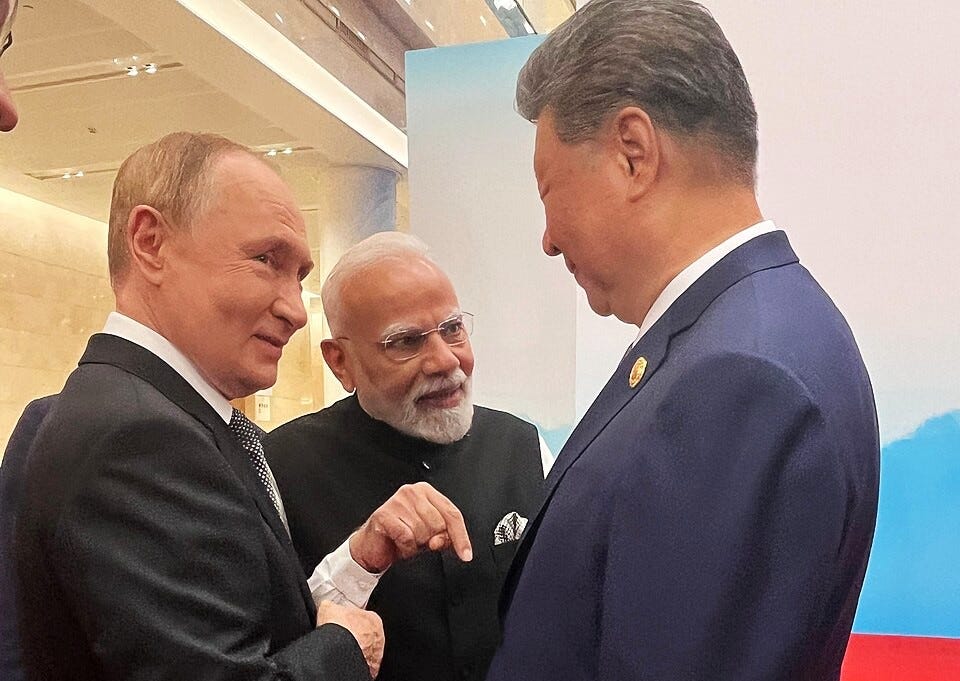
Developments at the SCO Summit caught President Trump’s eye, prompting him to take to Truth Social to remark:
“Looks like we’ve lost India and Russia to deepest, darkest China. May they have a long and prosperous future together!”
It is far too early to jump to this conclusion, however. Deep mistrust lingers between China and India, particularly given Pakistan’s close ties with the former, and longstanding border disputes will remain a continued source of concern.
Over time, the signposts to watch for will be the extent of new Chinese investment in India, particularly in sectors such as renewables, infrastructure and technology. According to Priyanka Kishore, director and principal economist at Asia Decoded, “signposts of real progress would include greater cross-border trade, and improved mobility of capital and labour. On India’s side, that means reviewing the ban on over 50 Chinese apps and reconsidering FDI restrictions on investments from countries with which it shares land borders.”
India’s push for strategic autonomy
Events this year have shown that Indian foreign policy is not driven by nostalgia for the Cold War days of Jawaharlal Nehru’s non-alignment, but the appeal of “strategic autonomy”. The idea is simple: to preserve maximum room for manoeuvre in international relations, with a view to pursuing Indian interests over everything else.
In our view, the concrete implications include the following in practical terms:
Stay close with Russia. India will keep buying Russian oil, US tariffs or otherwise. In 2020, it imported just 2.6m tons from Russia. By 2024, that figure had exploded to 88m tons—36.6% of all its crude imports. In August 2025, Russian shipments reached 2m barrels per day, nearly 40% of India’s intake. Trade off: risk continued strains with Washington, including tariffs, visa restrictions and possibly other negative policy responses.
Test waters with China. India’s engagement with China will remain measured and transactional, dictated by need and leverage. For now, it will focus on a security balance. For China, the gain from improved relations will be the increased influence of groupings such as BRICS and SCO, which are increasingly being seen as a counter to the Western order, but are driven by China.
Don’t drift too far away from the US. The relationship is vital for technology, investment and strategic heft. But Modi will not be seen to acquiesce to US demands. And India doesn’t necessarily see the US as a natural partner.
Re-engage ASEAN. Goods trade between India and the Association of Southeast Asian Nations (ASEAN) almost doubled between 2015 and 2024 to US$107bn. Meanwhile, Singapore alone has funnelled almost US$172bn of FDI into India since 2000, accounting for almost a quarter of all inflows into India in this time. The Indian commerce minister’s dismissive jibe about talk of an ASEAN FTA as “silly” and his reference to some ASEAN countries as the “B-team of China” did not land well in the region. The onus is on Delhi to win back trust here.
Keep Europe in the frame. EU-India trade is already significant—over US$500bn in goods from 2021–24—and Brussels offers technology, capital and diversification away from Washington. The EU, on the other hand, wants access to India’s growing market. Negotiations on a long-delayed FTA give India a chance to anchor itself more firmly in European supply chains. Brussels’ unease over India’s Russia ties remains a point of contention, exacerbated by the surprising spectacle of Indian troops participating in the Russia-Belarus Zapad-2025 military exercises in September. But the two economies are clear in their need to work more closely together.
The Washington question
The state of India-US trade tells a story. In 2005, India’s trade surplus with the US was US$8.2bn. By 2024, it stood at US$37.7bn. America is India’s single biggest export market, accounting for 18.3% of outbound trade in 2024. So while Modi might walk hand-in-hand with Putin, he’s always going to have one eye on the US.
Besides, thousands of Indian students study at US universities, and the Indian diaspora in the US sends home billions of dollars in remittances each year. The ties that bind India and the US are deep, and personal.
Rachel Ziemba of Ziemba Insights argues that Trump’s latest threats are more threat than substance: “The damage to the US-India relationship likely limits further India-alone tariffs. At present, I still see Trump’s secondary tariff threat as more political theatre given the costs of implementing tariffs on China.”
But Ziemba cautions that India’s oil trade will come under pressure from new EU regulations targeting refined products made from Russian crude. Russia’s own oil and gas export capacity, she notes, is easing, due to Ukrainian drone attacks on Russia’s energy infrastructure.
For its part, India has asked Washington to allow it to purchase oil from Iran and Venezuela to offset the loss of Russian imports, if it were to eventually reduce its imports of Russian crude. The US response will be indicative of the administration’s thinking; and a positive response could offer an offramp for the relationship—if indeed the US tariffs were imposed for this reason, and not, as some reports suggested, Trump’s offence at Modi’s refusal to nominate him for a Nobel Prize for his role in resolving the India-Pakistan dispute.
The bigger picture: using agency to serve self-interest
What is often missed in Western commentary is that India—and other important emerging powers—now not only have real agency, but the will to exercise it. American actions under the Trump administration have encouraged so-called “middle powers”, like India but also Brazil, Saudi Arabia and others to test this agency to shape outcomes to suit their national interests.
India is seeking to turn its size, its influential (and wealthy) diaspora, its market and its military into leverage. It is also one of the world’s largest arms importers and could use that as a political tool. At the time of writing, news reports are suggesting India is considering the use of French-made engines for its fighter jets instead of those it planned to jointly manufacture with the US.
In the near-to medium-term, we expect India to become more assertive. Modi remains popular, and the initial indications are that Modi’s posturing in terms of “standing up to Trump” is working for him domestically. A recent survey shows that 69% of Indians support the continued purchase of Russian oil. And while 63% are concerned about tariffs, 61% also believe India should not compromise on its interests in negotiating with the US.
For businesses and policymakers, the message is clear. India’s trade, security and foreign policy is going to be opportunistic, driven by India’s national interests and desire to operate with “strategic autonomy”. India will buy from Russia, trade with Europe, and take Japan’s investment. And will continue to do all of this with the US too—as long as it can maintain the delicate balancing act necessary to do so.
This piece was written as a guest post for Fordham Global Foresight and was first published here.